

Andy Goldsworthy – A Look at Nature Artist Andy Goldsworthy

Andy Goldsworthy is an English sculptor, photographer, and writer known for site-responsive works made in rural, urban, and gallery settings. His practice ranges from brief arrangements of leaves, ice, rain, and stone to permanent walls and architectural commissions. Change is not simply damage to these works: weather, time, labor, and the history of a place are active parts of their form, while photography and film carry many temporary works into books and exhibitions.
Andy Goldsworthy Biography
Andy Goldsworthy (born in Cheshire in 1956) is an English sculptor, photographer, and writer associated with land artist practices. Since the mid-1970s, he has made ephemeral outdoor sculptures, permanent site-specific installations, photographs, drawings, and films. Materials and methods vary by project, but close attention to place and to physical change runs through the complete body of work.
Goldsworthy is especially recognized for sculptures that may last only until a tide, thaw, wind, or rainfall changes them. That emphasis should not obscure his durable commissions or the status of his photographs as exhibited works. The National Gallery of Art in Washington, D.C., holds an extensive group of his works, while Storm King Art Center in New York maintains two monumental walls. Goldsworthy moved to Dumfriesshire in 1985 and continues to live and work in Scotland.
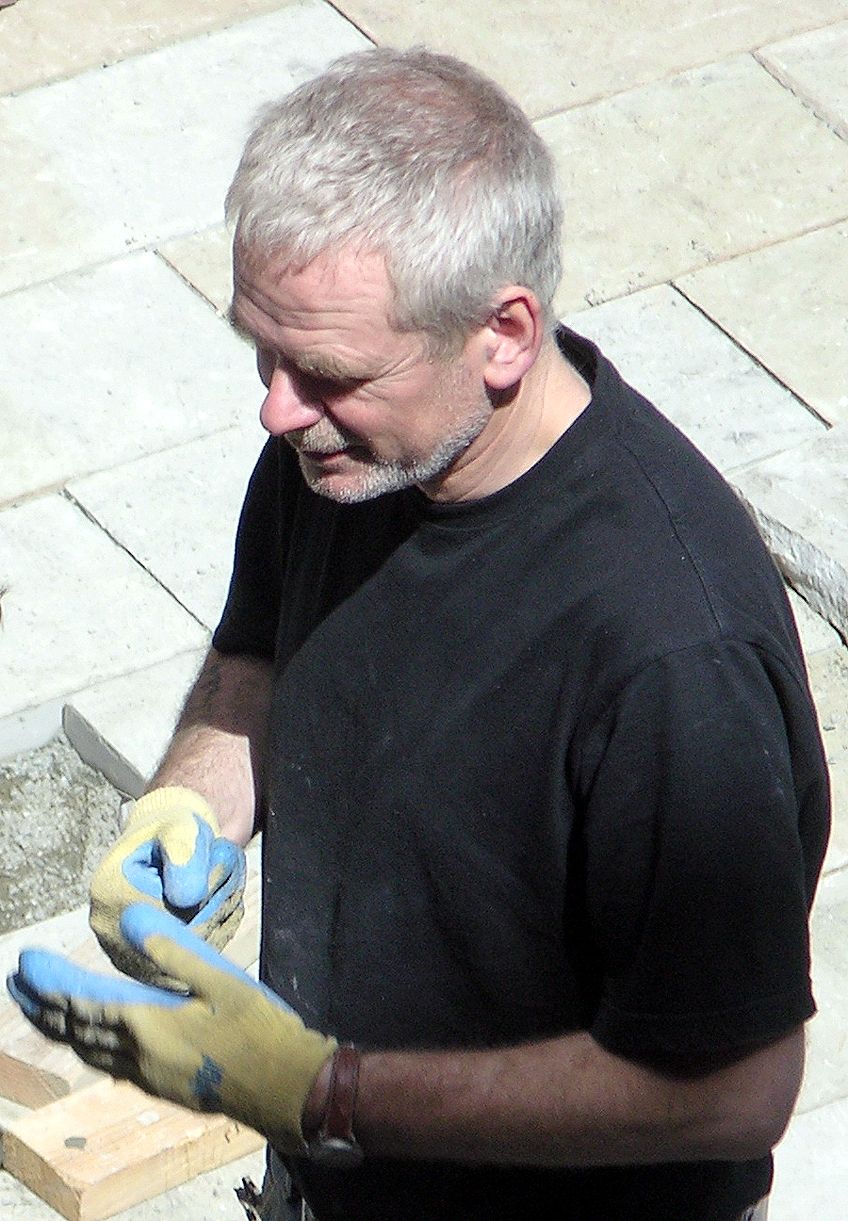
Born in Cheshire and raised in West Yorkshire, Goldsworthy began working on farms at about age 13. Repetitive physical tasks, seasonal rhythms, and the practical knowledge embedded in agricultural work later informed the way he described sculpture. The experience also gave him sustained contact with working landscapes rather than an abstract idea of untouched nature.
He has likened the rhythm of farm labor to the absorption required when making sculpture. Goldsworthy took a foundation course in fine art at Bradford College of Art from 1974 to 1975, then studied at Preston Polytechnic from 1975 to 1978. Preston Polytechnic later became part of the University of Central Lancashire.
During his studies, Goldsworthy encountered the work of British artists who followed an environmental philosophy, including Hamish Fulton and Richard Long; his own practice soon centered on making directly in the places he was trying to understand.
During his student years, Goldsworthy began working outside rather than treating the studio as his only site. Some early sculptures were made on the beach at Morecambe Bay, close to Preston, where the returning tide exposed the work to immediate change.
Goldsworthy’s gradual move north took him through Yorkshire, Lancashire, and Cumbria before he settled in Langholm, Dumfries and Galloway, in 1985 and later in Penpont. His art is often discussed in relation to the 1960s and 1970s Land Art generation represented by Robert Smithson. Yet Goldsworthy’s early interventions were usually intimate, temporary, and made through bodily contact with locally available material rather than through the monumental reshaping of terrain.
Goldsworthy is also situated within the Environmental Art movement alongside figures such as Chris Drury and Richard Long. In ephemeral works he commonly responds to materials at hand—stones, sticks, leaves, branches, snow, ice, rain, and mud—but this is a working method rather than an absolute rule for every commission.
Photography has been part of Goldsworthy’s process since his student days. For many ephemeral sculptures, his photographs are the principal lasting record and the form through which the work becomes public. Drawings, handwritten observations, sequences, books, and later film further complicate the familiar idea that only a vanished object counts as the artwork.
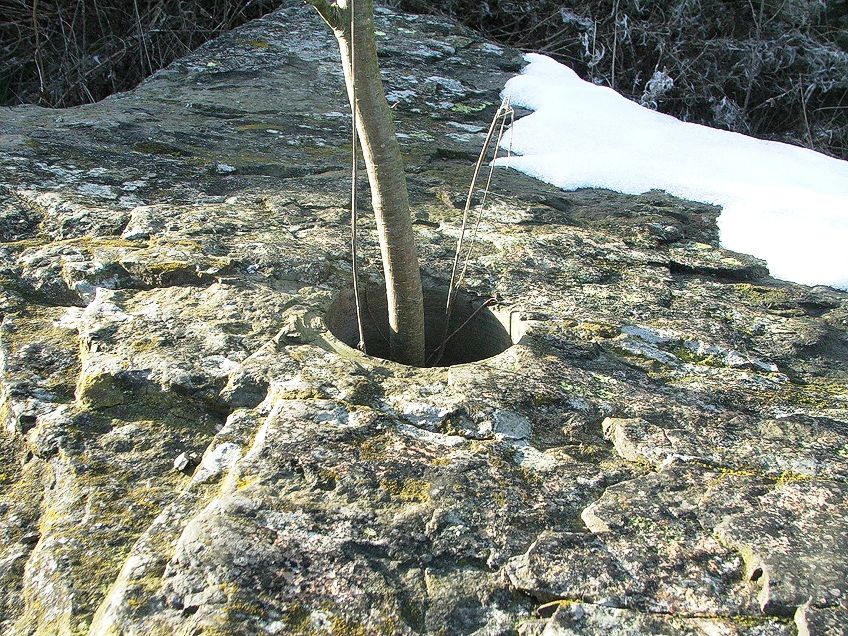
Goldsworthy’s practice treats people as participants in nature rather than observers standing outside it. The land in his work is often farmed, fenced, quarried, planted, or built upon; it contains histories of labor and ownership as well as growth and weather. This broader view explains why he works in cities and buildings as well as fields, rivers, forests, and coastlines.
From 2000 to 2008, Goldsworthy served two appointments as an Andrew D. White Professor-at-Large at Cornell University in Ithaca, New York. Thomas Riedelsheimer’s documentaries Rivers and Tides: Andy Goldsworthy Working with Time (2001) and Leaning into the Wind: Andy Goldsworthy (2017) show the artist’s ephemeral processes, permanent projects, urban actions, and increasing use of his own body. Goldsworthy was appointed an Officer of the Order of the British Empire (OBE) in 2000.
Goldsworthy does not use landscape as passive scenery. Gravity, moisture, temperature, light, growth, and decay materially affect what viewers see. His recurring circles, holes, arches, cracks, and serpentine lines make those forces legible without pretending that a place is static or separate from human activity.
The key distinction in Goldsworthy’s work is not simply between permanent and impermanent art. It is between different rates and forms of change: a leaf chain may disperse in minutes, while a dry-stone wall alters across decades.
Andy Goldsworthy Art Style
Andy Goldsworthy’s art is defined less by one visual style than by a method: sustained attention to a place, close testing of material, and repeated forms such as holes, circles, lines, arches, and cracks. Those geometric forms can be related to the formal language of the Modernist era, but their exposure to weather and their dependence on a specific site keep them from functioning as autonomous shapes.
For small ephemeral works, Goldsworthy learns by handling and testing what is available. Water can hold leaves to a surface, saliva can join petals, thorns or grass stalks can pin and stitch, and cold can bind pieces of ice. The process demands patience because temperature, light, wind, and moisture determine both what can be made and how long it will hold.
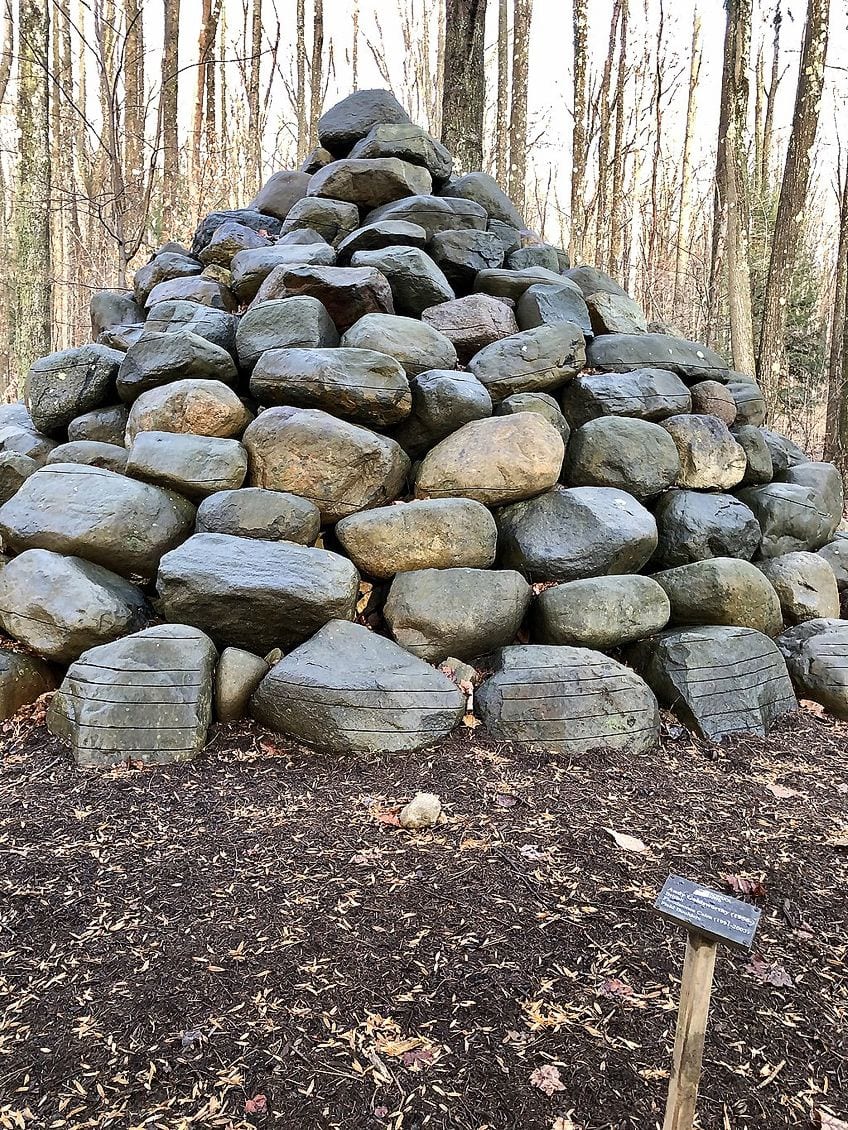
Goldsworthy’s materials include snow, ice, leaves, petals, grass, mud, pinecones, stones, clay, thorns, reeds, and branches. He may arrange them as a line, patch, sphere, arch, cairn, wall, or opening, drawing attention to color, structure, and an existing force such as flow. Ephemeral works change in place and are often encountered publicly as photographs; permanent commissions and gallery installations operate on different time scales.
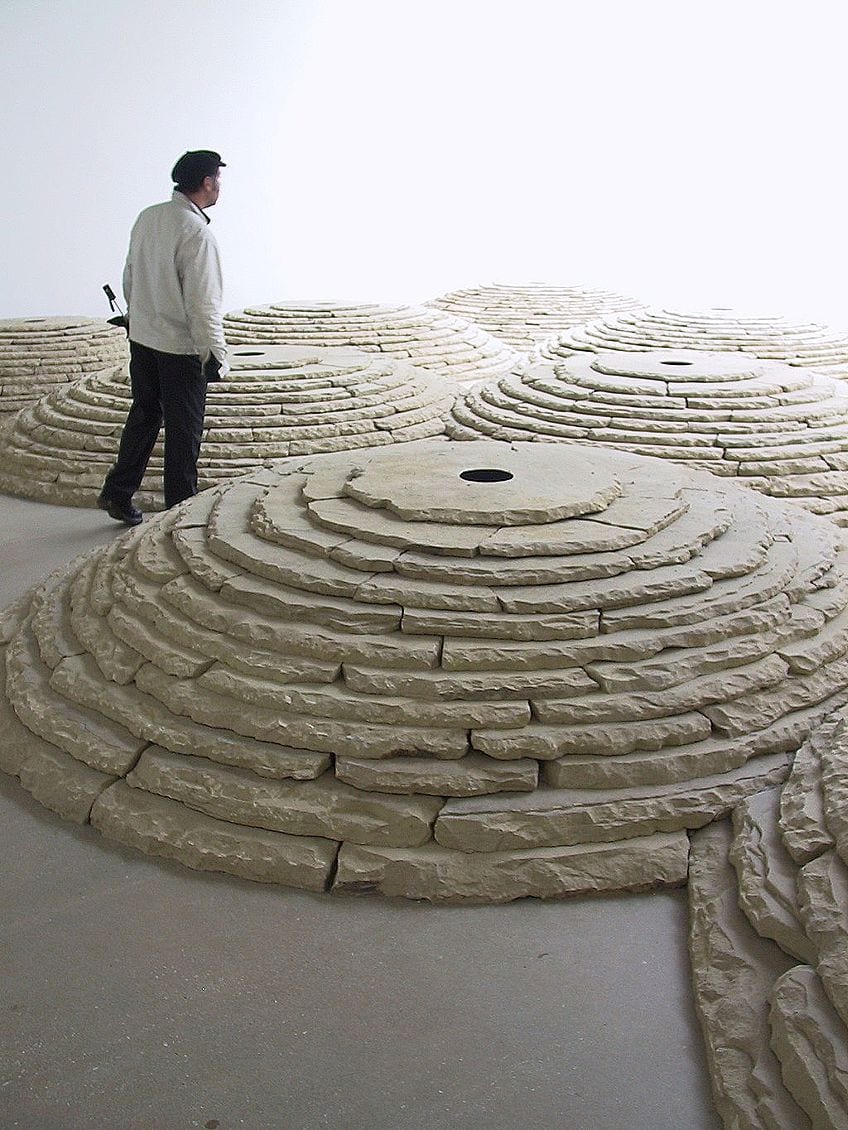
The familiar description of Goldsworthy working with his hands, teeth, and found tools applies chiefly to intimate ephemeral pieces. Permanent projects may involve drawings, quarried material, machinery, engineers, and skilled crews. Roof (2004–2005), made for the National Gallery of Art in Washington, D.C., consists of nine hollow domes built from Buckingham Virginia slate with the assistance of five British dry-stone wallers.
Goldsworthy’s close attention to shifting light and weather has prompted comparisons with a modern-day Impressionist. The analogy is useful only up to a point. Unlike traditional plein air paintings, his interventions are sculptural actions in which the material and conditions of a place help determine the result.
Goldsworthy may sew pine needles or leaves together, join petals with saliva, balance stones without mortar, or let water and wind carry a structure away. Such actions make change visible, but they do not amount to a simple celebration of harmony. Failure, resistance, danger, bodily effort, and the social history of worked land are equally important.
Goldsworthy’s recurring themes include change, flow, growth, fracture, enclosure, and passage. The work can be visually delicate while still addressing hard labor, barriers, loss, and the pressures that shape a landscape.
Snow and ice were especially important materials during the 1980s, in works including Ice Arch (1982), Ice Ball (1985), Ice Star (1987), and Touching North (1989). Their forms depend on temperature and light, so melting is not an afterthought but part of how the sculpture unfolds. This approach reflects transience in nature; it does not mean that Goldsworthy rejects well-made or long-lasting art.
Andy Goldsworthy Photography
Photography is integral to Goldsworthy’s practice, but not because every work is short-lived. He has used photography since his student years, with archival examples dating to 1975. An ephemeral sculpture is normally photographed immediately after it is made and may be revisited as it changes.
For many temporary works, a photograph is the principal lasting evidence of the physical arrangement. It is also a carefully made photowork: framing, depth of field, exposure, light, and the choice of moment determine how the sculpture becomes visible to an audience that was not present at the site.
Goldsworthy also records making, failure, decay, permanent commissions, and temporary gallery installations. Photographic sequences, handwritten captions, and books can show duration more fully than a single finished view. This is why the photographs operate as more than neutral records even though they arise from sculptures made elsewhere.
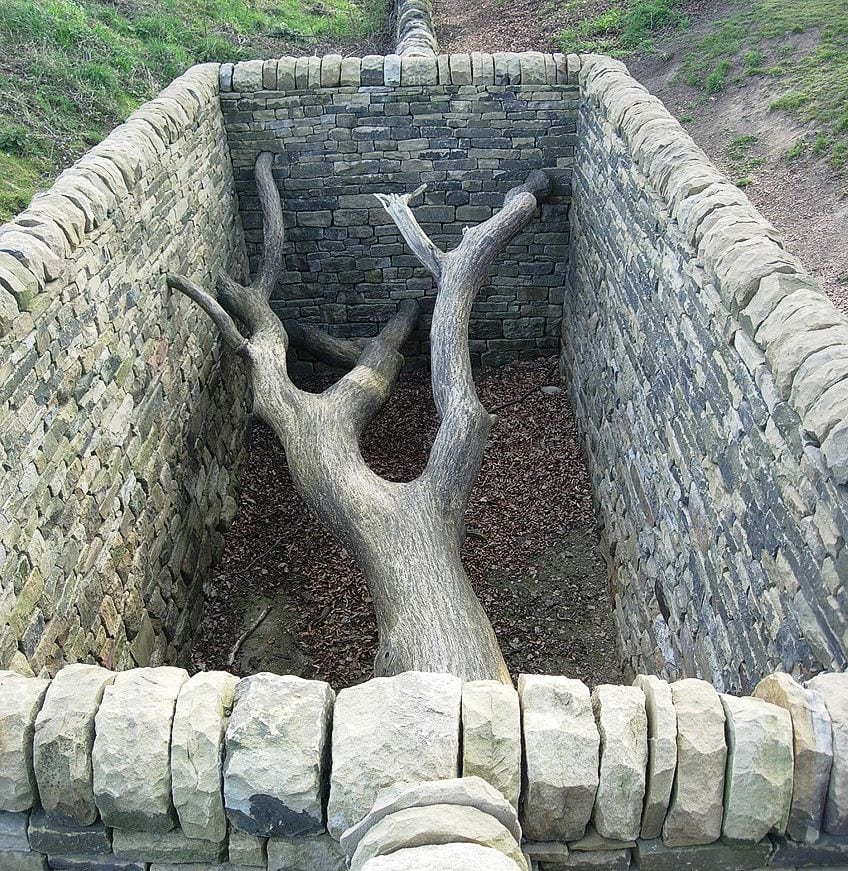
Permanent works are photographed too, although not with the same consistency as ephemeral pieces. Goldsworthy may document a wall during construction, at completion, or when returning later. A durable work therefore has a continuing physical life and a photographic history; permanence means slower change, not immunity from it.
The gap between the sculpture and its image is central to understanding Goldsworthy. A photograph fixes one encounter, while the work at the site may already have altered or disappeared. The image makes the event shareable without reproducing its temperature, movement, scale, or bodily effort.
The photographs leave the reason and spirit of the work outside. They are not the purpose but the result of my art.
— Andy Goldsworthy, “The Photograph,” reproduced in the Andy Goldsworthy Digital Catalogue
Moving images extend this investigation by showing actions and transformations that a still photograph cannot. Goldsworthy has used video for works such as later Rain Shadow projects, while documentary films and institutional interviews reveal the testing, collaboration, collapse, and revision behind finished pieces.
Photography and film therefore mediate between a private or remote act of making and its public life in a gallery, publication, or collection. They do not replace the original encounter; they translate it into another medium with its own limits and visual force.
Andy Goldsworthy Artwork: Most Famous Pieces
Selected Andy Goldsworthy artworks show why his practice cannot be reduced to temporary arrangements in untouched nature. The following examples range from an ephemeral leaf work and a bodily action to permanent dry-stone commissions made with specialist crews.
Japanese Maple Leaves
The work commonly called Japanese Maple Leaves was made at Ouchiyama-mura, Japan, on November 21, 1987. Its fuller descriptive title records the process: each Japanese maple leaf was stitched to the next with its stem to make a floating chain. The temporary arrangement survives publicly through a color photograph.
What Is the Medium of Andy Goldsworthy’s Japanese Maple Leaves?
The physical medium of Goldsworthy’s temporary sculpture was Japanese maple leaves joined by their stems and placed on water. In museum collections, however, the surviving object is a color photograph. Distinguishing the leaf construction from its photowork clarifies how material and documentation operate together in Goldsworthy’s art.
The brilliant red leaves become especially intense against water and the surrounding landscape. Yet color is not merely decorative here: the chain’s buoyancy, the joins between leaves, and its exposure to current and drying make fragility and movement part of the image.
Rain Shadows
Goldsworthy began making rain shadows in 1984 by lying on a surface during rainfall so that his body left a dry silhouette. An early documented example, Rain shadow, was made at St. Abbs, Scotland, in June 1984; another was made in Haarlemmerhout, Holland, that August. These works use the body rather than found objects to interrupt weather briefly, and photographs record the result before the surrounding ground dries.
Storm King Wall
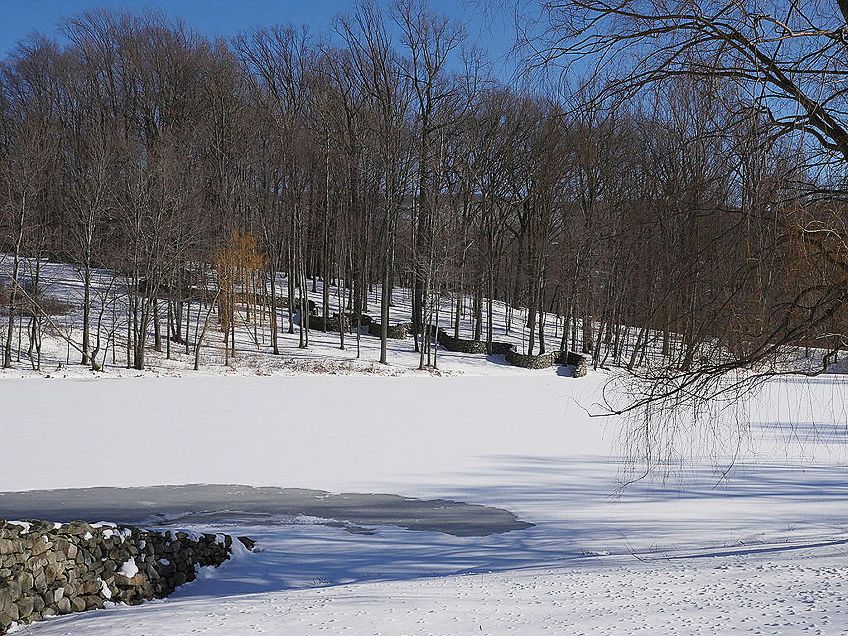
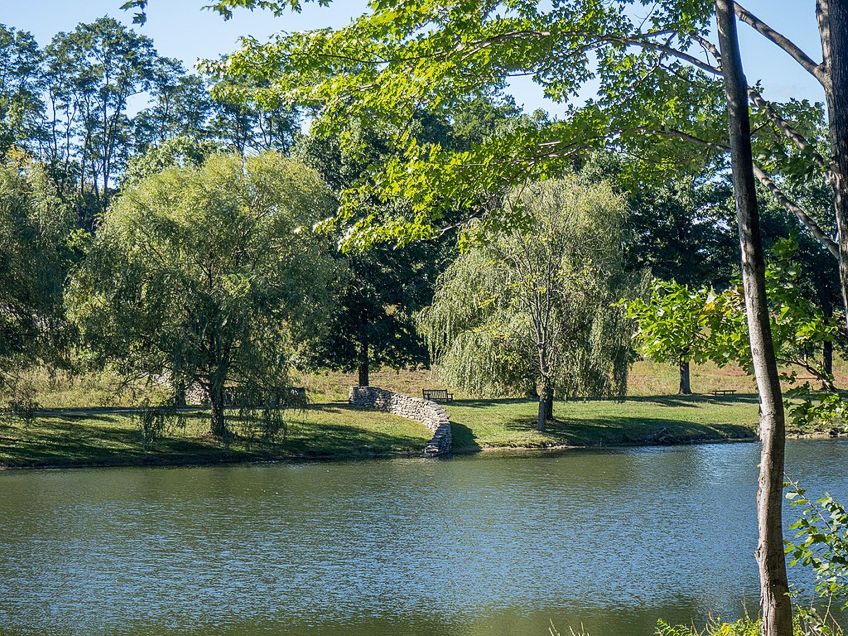
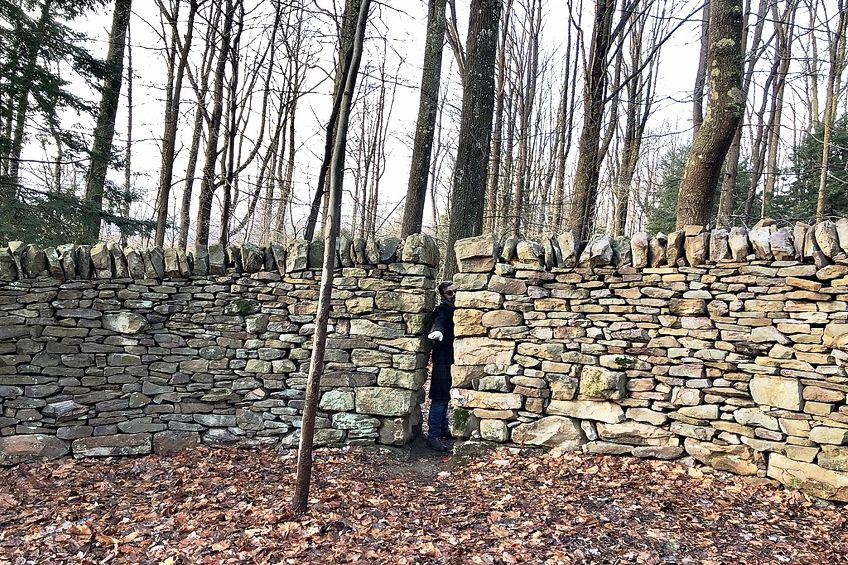
Created in 1997 and 1998, Storm King Wall was Goldsworthy’s first museum commission for a permanent work in the United States. It was initially planned as a 750-foot dry-stone wall through the woods, but Goldsworthy extended it downhill to a pond, visually continued it on the far bank, and carried it uphill toward Storm King’s western boundary.
The completed fieldstone wall measures 2,278 feet overall and rises to a maximum height of about five feet. Parts were built on remnants of an old farm wall, while the new course winds among trees that may have contributed to the earlier wall’s collapse. The route connects the land’s agricultural history to its present topography rather than simply decorating the site.
Goldsworthy conceived and supervised the work, while five British master wallers built it from 1,579 tons of fieldstone. They shaped and fitted foundation stones, through stones, and capstones without concrete, using the craft of dry-stone construction to give the wall stability.
A good wall is drawn, it expresses the landscape through which it travels.
— Andy Goldsworthy, reflecting on Storm King Wall
Five Men, Seventeen Days, Fifteen Boulders, One Wall
In 2010, for Storm King’s 50th anniversary, Goldsworthy returned with the walling team to create Five Men, Seventeen Days, Fifteen Boulders, One Wall. The installation occupies a field that had interested him during his first visits to the art center.
Over 17 days, Goldsworthy and the wallers altered a dilapidated 309-foot fieldstone wall, rebuilding its central span while allowing the ends to taper like a ruin. The wall winds around 15 existing boulders along a grove of trees, making those obstacles part of its course rather than removing them.
Exhibitions
Goldsworthy has exhibited internationally, but several institutional projects are especially useful for tracing his development. Hand to Earth: Andy Goldsworthy: Sculpture 1976–1990 opened at Leeds City Art Gallery in 1990 and traveled, bringing together early sculpture and photography from the formative period of his practice.
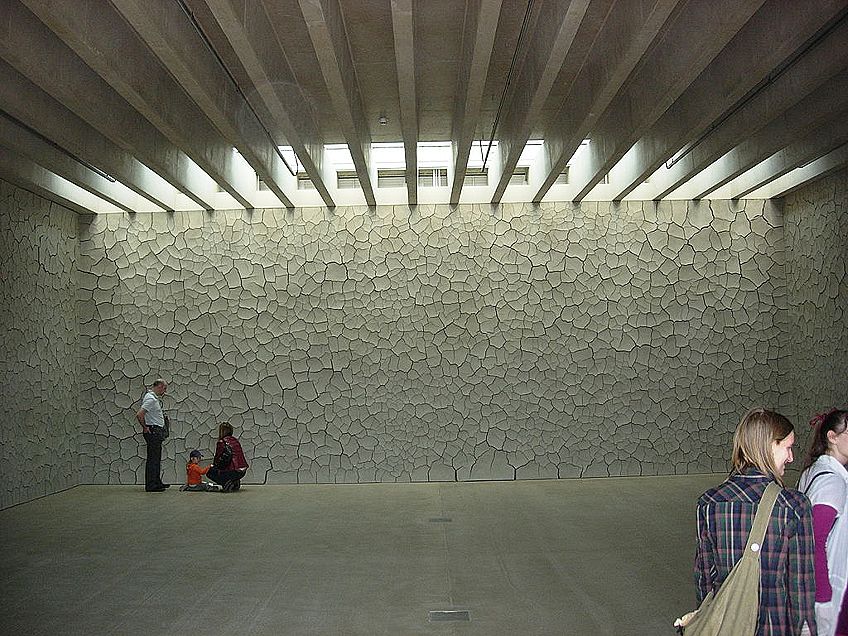
The 2007–2008 exhibition at Yorkshire Sculpture Park joined photographs of ephemeral works with major indoor installations and outdoor sculptures. Its combination of gallery and landscape allowed visitors to encounter walls, enclosures, trees, clay, stone, and organic material directly rather than only through photographs.
In 2025, the National Galleries of Scotland organized Andy Goldsworthy: Fifty Years at the Royal Scottish Academy in Edinburgh. The largest indoor exhibition of his work to that point included more than 200 installations, drawings, photographs, films, sketchbooks, and archival items dating from the mid-1970s. Goldsworthy conceived the exhibition as a single immersive response to the building.
The retrospective emphasized the working land and its tensions: wool and oak, but also gravestones, barbed wire, fences, cracked clay, danger, and bodily labor. That breadth challenges the idea that Goldsworthy’s art is limited to decorative arrangements of natural materials or to an uncomplicated vision of rural harmony.
Final Thoughts
Andy Goldsworthy is closely associated with Land Art, but his career complicates that label. He has made temporary outdoor sculptures, permanent public commissions, indoor installations, photographs, books, drawings, and films. Across these forms, change is a material condition rather than a slogan: a work may collapse quickly, weather slowly, or be reactivated through documentation and return visits.
Goldsworthy lives and works in Scotland, and the 2025 retrospective Andy Goldsworthy: Fifty Years demonstrated the continuing range of the practice. Its combination of fragile materials, hard barriers, agricultural references, film, and large installations made clear that his subject is not nature as an escape from human life, but the changing relationship between people and the places they inhabit.
For Goldsworthy, nature is not confined to remote countryside. It is present in cities, buildings, farms, forests, weather, labor, and the human body; art becomes a way of understanding the connections and conflicts among them.

Isabella studied at the University of Cape Town in South Africa and graduated with a Bachelor of Arts majoring in English Literature & Language and Psychology. Throughout her undergraduate years, she took Art History as an additional subject and absolutely loved it. Building on from her art history knowledge that began in high school, art has always been a particular area of fascination for her. From learning about artworks previously unknown to her, or sharpening her existing understanding of specific works, the ability to continue learning within this interesting sphere excites her greatly.
Her focal points of interest in art history encompass profiling specific artists and art movements, as it is these areas where she is able to really dig deep into the rich narrative of the art world. Additionally, she particularly enjoys exploring the different artistic styles of the 20th century, as well as the important impact that female artists have had on the development of art history.
Learn more about Isabella Meyer and the Art in Context Team.
Cite this Article
Isabella, Meyer, “Andy Goldsworthy – A Look at Nature Artist Andy Goldsworthy.” Art in Context. March 8, 2021. URL: https://artincontext.org/andy-goldsworthy/
Meyer, I. (2021, 8 March). Andy Goldsworthy – A Look at Nature Artist Andy Goldsworthy. Art in Context. https://artincontext.org/andy-goldsworthy/
Meyer, Isabella. “Andy Goldsworthy – A Look at Nature Artist Andy Goldsworthy.” Art in Context, March 8, 2021. https://artincontext.org/andy-goldsworthy/.


.jpg)
.jpg)

.jpeg)

